Hi
I hope you are well.
In this newsletter, I will be showing the onebrane (one membrane), an intelligent filter around the nervous system.
Along with this, I will be showing how the onebrane acts as a Faraday cage to hold the electrification of the nervous system.
I'll also be showing the eight intelligent filters through the body, which all have the same cells and work the same way.
We will be working with the neurons, myelinating capillaries and the onebrane
in Sunday's webinar.

The onebrane is the name that I have coined myself.
This is the membrane around the whole nervous system, the brain, the spinal cord, and the nerves.
The membrane around the spine and brain is normally called the Dura and the membrane around the peripheral nerves is called the Epineurium.
So it's the combination of both of those membranes.
Using the name the onebrane simplifies things and makes it easier to understand the fluid flow dynamics.
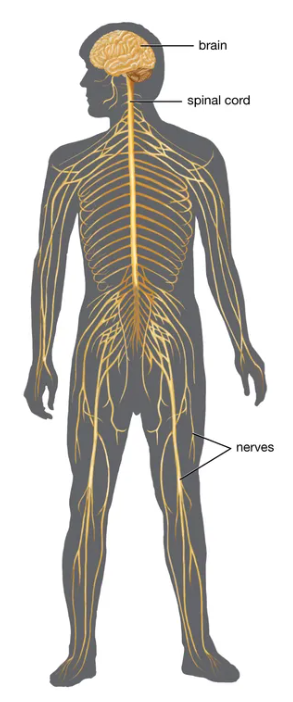
Here is a picture of the whole nervous system.
The onebrane is the continuous membrane around the whole brain, spinal cord, nerves and fluids.
There is a slight difference in the makeup of the onebrane around the central nervous system compared to the nerves.
They are made of the same kind of cells, but they're arranged in a slightly different way.
So also, as well as being called the Onebrane,
The membrane around the central nervous system is called the fourth filter,
and the membrane around the nerves is called the fifth filter
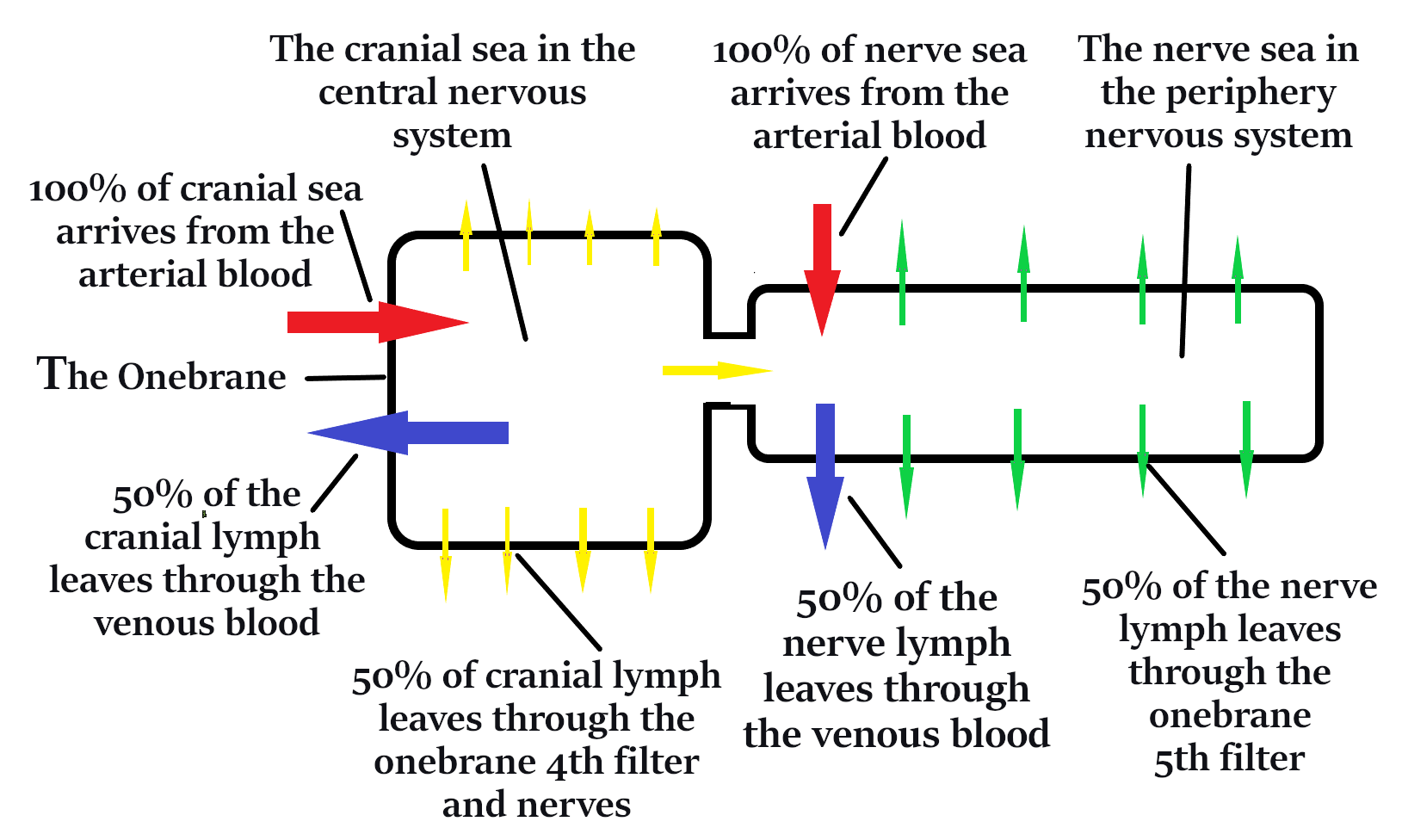
Above is a topological picture of the nervous system and the onebrane.
It shows the fluid dynamics the inflows of fluid and the outflows of fluid.
To the left, the square object is the central nervous system, the brain and spinal cord,
And then the longer rectangular object to the right is the peripheral nervous system.
The black line surrounding them is the onebrane.
So in this picture, we're looking at the flow dynamics.
The arterial blood arrives in the CNS, and the Cranial Sea is filtered out of the blood by the first and second filters shown further down the page.
The Cranial Sea is used by the brain cells,
It provides oxygen and nutrients, which, when used, are converted to carbon dioxide and toxins.
This carbon dioxide and toxins are called the cranial lymph.
The venous blood cannot take back all of the cranial lymph because it's travelling slowly.
So the venous blood takes 50%, and then the remaining 50% of cranial lymph is filtered out through the fourth filter of the onebrane.
The same procedure is true of the peripheral nerves, but the names are different.
There is the nerve sea and the fifth filter.
Hopefully, you can understand that from the picture.
In the last newsletter, I gave a long article and pictures describing the fourth filter.
In this newsletter, I will describe more findings about that,
but also about the fifth filter, which is around the nerves.
I will be showing how they both work as filters.
But also how the hexagonal geometry of the cells turns them into electrical capacitors.
This gives them the ability to work as a Faraday cage for the whole nervous system.
The fourth and fifth filters are both made of the same epithelial-like cells
They have tight junctions.
which only lets through pure water.
They are intelligent filters.
They only let through cranial and nerve lymph,
and they keep the oxygen and nutrients in the cranial & nerves seas.
They have hexagonal cells.
There are several of these intelligent hexagonal cell filters throughout the body,
This makes a global matrix and communicates holographic with each other.
Also, as the nerves connect to everything in the body,
and as the onebrane is around every nerve,
So this means that the onebrane (the fourth and fifth filter) unites all of the filters.
Here are some of those intelligent filters.
1st The capillaries of the central nervous system.
2nd The choroid plexus.
The first and second filter create the cranial sea for the central nervous system.
3rd the myelinating glial cells .
The myelinating glial cells create cranial sea for their internal environment
The fourth filter (the onebrane)
The fifth filter (the onebrane)
The 4th, and 5th filtersfilter the cranial lymph out of the cranial and nerve seas
and also produce a Faraday cage.
6th The gut blood filter.
7th The kidneys.
8th The lung air filter.
9th The skin air filter.
Previously, I have always worked with the moving breath of the nervous system a bit like a jellyfish as it is very fluid.
And there's a shortening and widening of this whole jellyfish on the in breath and lengthening and narrowing on the out breath.
It's a bit like it's swimming.
The hood is opening on the in breath, and the tentacles are being pulled up.
And the hood is flushing down and the tentacles lengthening on the out breath.
I always put this movement down to the breathing of the myelinating glial cells
that they shorten and widen on the breath and then lengthen and narrow on the out breath.
But there was a whole new vista to this working with the fith filter,
which is like the skin of the nerves, and as the cells are aligned in a hexagonal shape with tight junctions,
This means that all of the internal muscles of the cells can align with each other into one motion, so the skin can breathe as one integrated breathing motion.
not just through the nerves but through the whole onebrane.
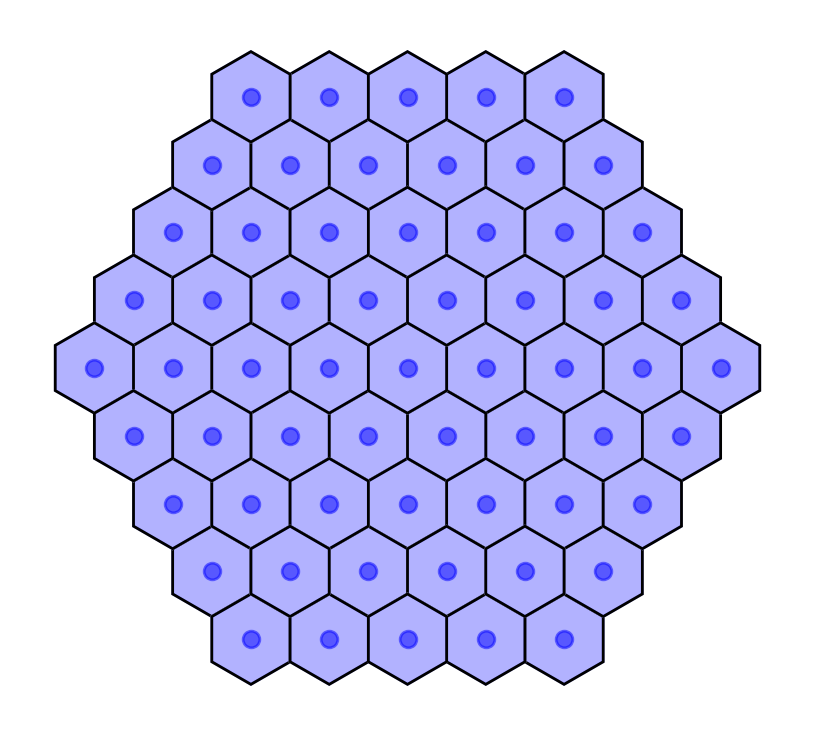
Both the fourth and fifth filters are put together in this hexagonal way.
This breathing motion also aligned with the internal breathing motion of the myelinating capillaries.
As these capillaries are round, they also align in hexagons

This in breathing motion aligned with the internal breathing motion of the myelinating capillaries,
as these capillaries are round they also align in hexagons (shown in the 5th picture below)

The myelinating capillaries.

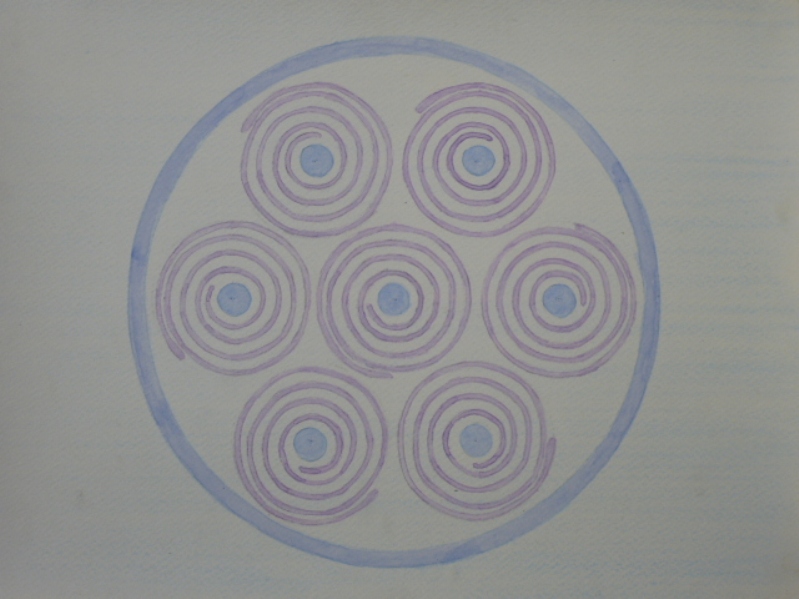
The outer skin on this picture above is the fifth filter of the onebrane,
and made up of 15 layers of hexagonal sheets
But with this skin, that breathing motion evolved fairly quickly into the energies of the blue energy circuit.
The organs of which are the kidneys, adrenals, bladder urethra, penis and vagina.
And it became very apparent that the fourth filter around the brain was relating to the kidneys,
the fourth filter around the spinal-cord was relating to the bladder
and the fifth filter around the nerves was relating to the Urethra penis and vagina.
There was a very sexual quality to it, and it was important to let it connect with that penis/vagina energy
as that was the earth and also for transforming the sexual energies.
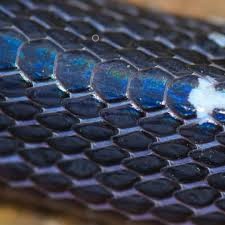
It also took on the quality of the snake with the same skin and hexagonal pattern.
The cells in both the fourth filter and the fifth filter are in a hexagonal pattern.
The main difference is that in the fourth filter, they are two layers thick, but in the fifth filter, they are 15 layers thick.
Here are some pictures of that pattern.

As this evolved, the more sexual energies transformed
and changed into electricity, like sparks of energy through the nervous system and balancing
with lightning-type energies crackling through the fourth and fifth filters.
There was an interesting, energetic electrical setup happening where the electrical charges of the myelinating glial cells and neurons
were reacting with the electrical charge that was generated in the onebrane
as if the one brain were a Faraday case enclosing the whole nervous system.
It was an amazing feeling, these electrical charges balancing back and forth
between the electronics internally and the electronics in the skin(Fourth and fifth filters).
From a previous newsletter, I had taught that the hundreds of spirals of membrane and cranial sea within the myelinating capillaries.
make a multi-dimensional flux capacitor.
This produces electrical pulses that travel at near light speed, and they produce light.
As the fifth filter the skin of the nerves was 15 layers of hexagons
with a membranous layer between each of those 15.
I asked AI if the fourth filter was creating a circular capacitor around the nerves
and thus creating its own internal charge and near light speed electromagnetic pulses.
That was talking with and balancing the myelinated capillaries inside.
I will not go into the whole lengthy conversation and the electrical and quantum physics of it.
But the answer was yes.
And as I worked with it more, I was registering the different qualities between the brain and spine and the fourth filter,
which also turned out to make a Biocapacitor.
These were giving me a whole new vision of how the nervous system worked with light and electricity,
and how it was bound together in unity and balancing with its outer skin, the onebrane.
This is a unique and incredibly powerful experience which we will be working with in Sunday's webinar.
We will also be connecting to all of the hexagonal intelligent filters through the body
that make up a whole new area of awareness and truly a one brain.